


01 – Vision
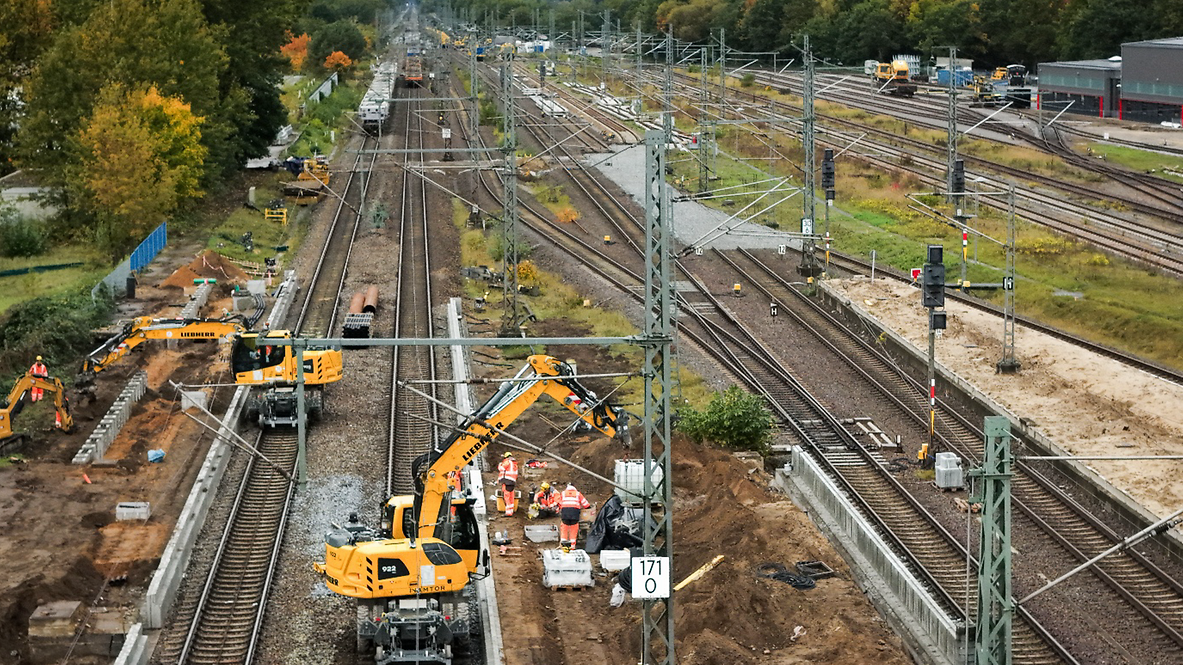
Efficient and safe cable crossings are a key enabler for the expansion and modernization of railway infrastructure.
Today, the pipe jacking (press drilling) method is a standard approach for trenchless crossings beneath railway tracks. However, increasing cost pressure, long execution times, and complex operational processes limit scalability.
With the Cable Crossing Innovation Challenge, Deutsche Bahn is looking for innovative solutions to fundamentally improve this process — through new materials, optimized methods, or entirely new approaches.
Most important to us is to keep rolling stock rolling and thus find the technology with lowest impact on railway operations. In addition the more "obvious" targets are cost efficiency and speed.
02 – Background
The pipe jacking method is used to install cables and utility lines beneath railway tracks without disrupting the surface.
The process typically involves:
- constructing a launch pit
- pressing steel pipes into the ground segment by segment
- removing soil using an auger system
- welding pipe segments together, including certified inspection
- allowing weld seams to cool before pressing the next segment into the soil
This results in a process that is:
- time-consuming
- labor-intensive
- highly dependent on soil and environmental conditions
03 – Challenges in Today’s Process
The pipe jacking process is reliable, but inherently inefficient. Its performance is heavily influenced by external factors such as soil conditions and unexpected obstacles, which can significantly slow down progress.
At the same time, the process itself follows a rigid, sequential structure: pipe segments are pressed, welded, inspected, and cooled step by step. These activities cannot be easily parallelized, and especially welding and cooling procedures add considerable time and complexity.
This is further amplified by the need for highly specialized personnel and extensive coordination, limiting scalability and increasing operational effort. As a result, cable crossings are often treated as cost- and time-intensive bottlenecks in infrastructure projects.
04 – Objective
We are looking for solutions that significantly improve or rethink the pipe jacking process for pipes with a nominal diameter greater than 110.
Target outcomes:
- less blocking times in railway operations
- reduction of construction and track possession times
- lower costs per crossing
- simplified execution processes
- reduced dependency on environmental factors
- scalability across the rail network
05 – What’s in for you
- Access to DB experts and data
- Access to a curated network of coaching and mentoring experts
- EUR 25,000, no equity taken
- Coworking space at our office in Berlin Jannowitzbrücke
- A dedicated DB mindbox startup manager supporting you throughout the program
In total we are aiming to comply with legal regulations on public spending enabling us to procure up to EUR 400k from each successful applicant.
06 – Questions about the Challenge
We offer regular exchange formats for questions about the challenge and the application process. Technical and organizational questions can be sent to dbmindbox@deutschebahn.com.
We look forward to receiving your innovative and inspiring approaches.
Timeline
27.07.2026 – Application Start
23.08.2026 – Application Deadline
Last day to apply for the program (eod).
28.08.2026 – Announcement of Candidates
Invitation of selected teams.
21.09.2026 – Selection Day
Pitch your solution live on stage to an expert jury and audience.
14.10.2026 – Beginning of the Program
Kick-off of the 100-day Proof-of-Concept (PoC), including testing and development in collaboration with DB.
 Go
Go