


01 – The Vision
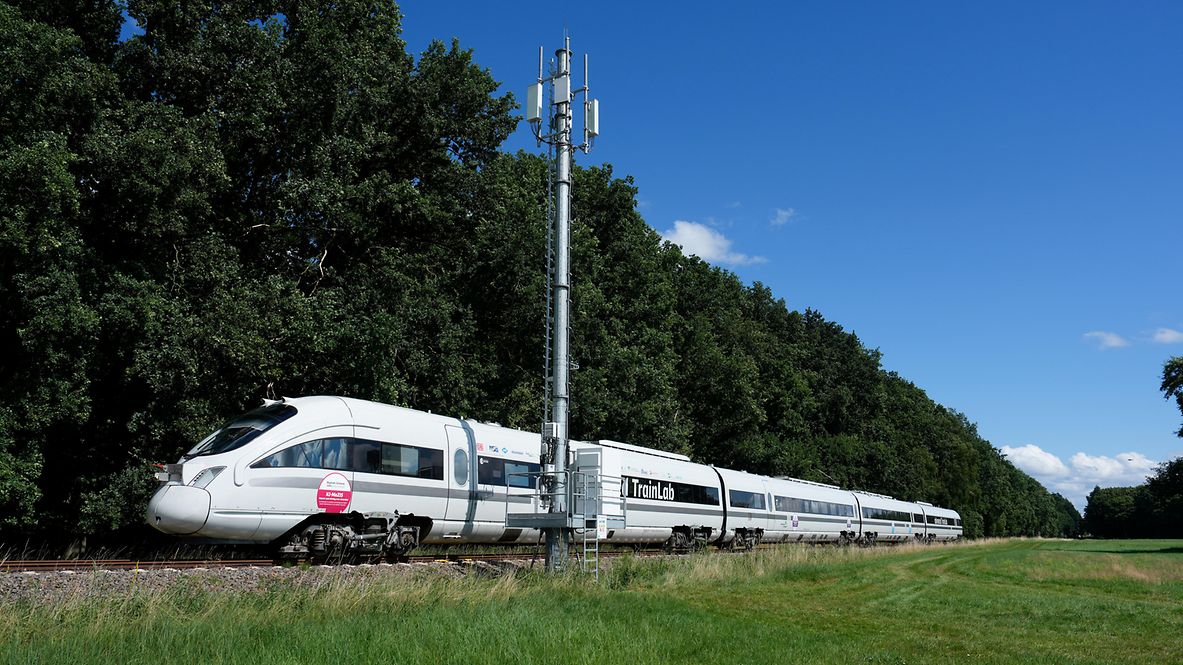
Modern inspection trains are a key component of an efficient, safe, and sustainable rail infrastructure. They record the condition of tracks, overhead lines, and other elements of the infrastructure with a high degree of accuracy, generating very large amounts of image, video, and sensor data in the process.
The technical challenge lies not in collecting this data, but in its reliable, automated, and scalable transmission to land-based systems.
With the Rail Data Transfer Challenge, we are joining forces with DB InfraGO to invite startups and technology companies to develop powerful system approaches that automatically and reliably transfer very large amounts of measurement data under realistic operating conditions – optionally supplemented by intelligent preprocessing on board.
02 – Background
An inspection train generates up to 10 terabytes of data per day of operation, consisting primarily of image, video, and high-resolution sensor data. At the end of the journey, this data is stored locally on the train. The measurement train is parked at a defined storage location for several hours each day when it is not traveling on the rail network. This downtime is to be used to transfer the stored data in batches to land-based systems.
The challenge:
Up to 10 TB of data must be transferred wirelessly, automatically, and under realistic environmental conditions within a maximum of 7 hours of net transfer time.
The distance between the land-based infrastructure and the train is at least 5 meters (distance to the center of the track). The parking location is realistic in terms of operation - with weather influences, limited accessibility, and regular operating conditions.
03 – Goal of the Challenge
The downtime of the train should be used to transfer up to 10 TB of data efficiently and automatically. The goal is a robust, scalable solution for regular operation.
The central question is therefore:
How can an overall system be designed that reliably transmits up to 10 TB of measurement data per day wirelessly to land within 7 hours under realistic operating conditions – and (optionally) is supported by intelligent preprocessing?
Minimum requirements for an overall technical system are:
- Wireless transmission of up to 10 TB within a maximum of 7 hours net time
- Minimum distance is 5 meters (distance to the center of the track)
- Fully automatic process without manual interaction on the train
- Data format: RCM-DX (input and output unchanged)
- Robust operation under realistic stabling conditions
- Line of sight only required if necessary for technological reasons
Optionally, intelligent preprocessing can be integrated on board, provided that the complete availability of all source data in the target system is ensured.
The aim of the Rail Data Transfer Challenge is to gain a deeper understanding of:
- which system architectures and technological approaches are currently suitable for handling very large amounts of measurement data (especially offloading while stationery),
- which combinations of (optional) preprocessing, compression/prioritization, and data transmission are currently realistic,
- which technological developments could become relevant in the long term (e.g., 2030+).
04 – What kind of teams are we looking for?
We are looking for startups and technology companies with experience in handling large data volumes, high-performance data transmission, or complex system architectures.
Relevant skills include:
- High-performance data transmission in the GB–TB range
- Wireless or stationary offload technologies (e.g., Wi-Fi, microwave radio, mmWave, hybrid approaches)
- Edge computing/edge data intelligence (optional)
- Handling unstable or intermittent connections
- Distributed or mobile systems
Rail experience is not required. Partial solutions or specialized components are also welcome, if it is clearly demonstrated how the minimum requirements (10 TB/7h/≥5m/automated/RCM-DX) are met.
05 – Focus of the Challenge
The challenge is not purely a comparison of upload speeds. However, up to 10 TB must be reliably transferred from the train to the ground-side system within 7 hours. The 7 hours refer to net data transmission time, including overhead, restart procedures, and error handling.
The focus is on:
- Realistic net throughput models (including overhead, restart, error handling)
- Robust system and architecture design
- Behavior in the event of connection interruptions (resilience, resumption)
- Data integrity, traceability, and monitoring
- Scalability to multiple locations
- Optional: intelligent preprocessing to support complete offloading
Future-oriented approaches are welcome, but not a mandatory evaluation criteria.
In general solutions must be realistically integrable into railway operations. Systems requiring permanently mounted large parabolic/dish antennas or creating significant wind loads are likely not considered practical.
06 – Process, format & timeline
The DB InfraGO Rail Data Transfer Challenge will be conducted as a multi-stage selection and work process. The aim is to use a structured procedure to select the teams that have the best technical understanding of the problem and can gradually refine their approach.
Application phase:
- Application deadline: March 22, 2026
- Feedback on participation in the challenge phases: by April 1, 2026, at the latest
Application documents to be submitted:
- Brief description of the company and the team (e.g., year of foundation, team size, relevant skills)
- Brief description of the solution or system understanding
- Description of the proposed wireless transmission technology, including performance and assumption model (e.g. “X TB in Y hours” net throughput under defined boundary conditions)
- Transparent presentation of all underlying assumptions (e.g. distance/geometry, Line of Sight yes/no, parallelization, restart and resumption concept)
- Clarification of the technological maturity level (e.g. existing product, market-ready prototype, planned new development) and expected stable net throughput in realistic operation
- Presentation of the basic system architecture (text or sketch)
- Explanation of how very large data volumes are handled (e.g. structuring, prioritization, optional preprocessing/data reduction). Data integrity must be verifiably ensured (e.g. via checksums/hashes)
- Infrastructure and operational requirements at the storage location (e.g., hardware, installation, operation/maintenance, automation, remote operation, security by design)
- Risks and dependencies (e.g. frequencies, approvals, integration, safety/EMC)
- Rough cost estimate (especially additional infrastructure, scaling to multiple locations)
If data reduction or prioritization is part of the solution:
- Concept for data reduction/prioritization onboard (data classes, expected reduction factor, handling of quality/integrity, and ensuring complete raw data availability)
Phase I: Concept phase (Top 5) – Challenge days April 27-30, 2026
The challenge starts with the challenge days, a concept phase that is expected to take place exclusively online.
- Virtual onboarding and technical deep dive with DB experts (April 27)
- Independent development of a technical overall concept by the companies, including a Q&A session and sparring appointments with DB InfraGO technical experts (April 28 & 29)
- Online presentation of the concepts to the technical experts on April 30. Three winning teams will be selected.
Phase II: In-depth phase (top 3) – May 11-13, 2026
- In-depth development of the concepts
- Implementation of a mini-prototype or simulation of key elements in an on-site meeting
- Focus on system logic, feasibility, and robustness
- Mostly remote, with occasional joint meetings
At the end of the challenge, the teams will present their results in person to experts in the field. One team will be selected for the subsequent 100-day proof of concept.
100-day proof of concept – starting June 8, 2026
The winning team will take part in DB mindbox's 100-day proof of concept program. During this phase, which starts on June 8, 2026, the solution will be tested in real-world conditions in collaboration with Deutsche Bahn and further developed if necessary.
07 – Financial Support and Value for Participating Teams
Financial support for participation in the DB InfraGO Rail Data Transfer Challenge is based on fixed amounts:
- Each selected team (TOP 5) in the concept phase will receive a one-time payment of €1,500 for participating in the challenge days.
- Each team (TOP 3) that also completes the in-depth phase in May and participates in the results presentation (Selection Day) will receive an additional one-time payment of €4,500.
- In addition, travel expenses (travel costs, hotel accommodation) for attendance at events as part of the challenge can be reimbursed up to an amount of €500 per team upon presentation of receipts.
In the 100-day proof of concept:
- €25,000 in funding (without equity participation)
- Personal support from a DB mindbox startup manager
- Access to experts, specialist departments, and relevant contacts
- Optional use of the DB mindbox coworking space in Berlin
 Go
Go