


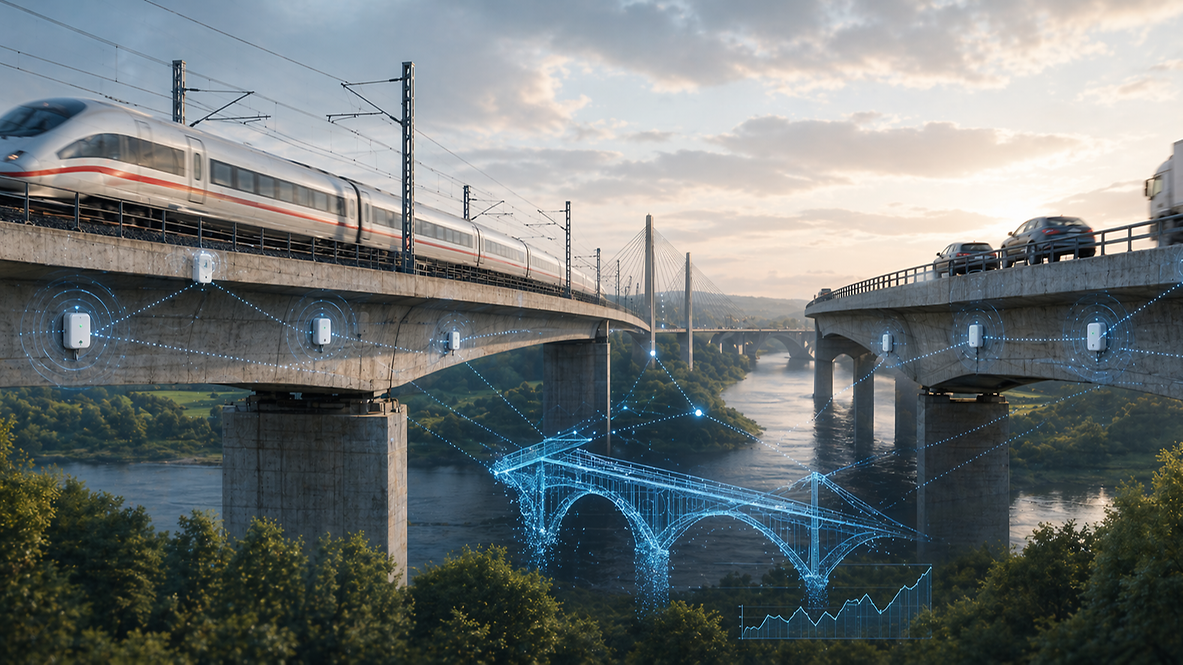
Article: Bridge Monitoring Challenge – Further information
Establishing Fiber Optic Sensors
Background
Fiber optic sensors are constantly evolving. Newer materials can record other measurands (e.g., temperature, strain, vibration) beyond pure strain changes to determine the condition of a bridge.
There are exciting applications for fiber optic sensors in structural health monitoring in existing buildings. However, the heterogeneous structural nature of bridges in Germany poses challenges for the development of scalable monitoring applications that are compatible with regulations.
The central question is therefore:
Can the development of damage in existing buildings be observed on the basis of measured structural behaviour even before the visible damage – and thus enable maintenance measures to be taken before traffic-restricting measures become necessary?
Objective
We want to introduce an innovative, scalable solution that
- allows sensors to be attached to a wide variety of bridge types (steel vs. vault)
- Predict load limits on bridges to prevent critical damage
- helps to decide which maintenance measure would be best
- can assess the effect of a repair measure
- is data-efficient and can be used in the most resource-efficient way possible.
The long-term goal behind this is an economically comprehensive, 24/7 available and operationally viable bridge monitoring solution using fiber-optic sensors.
The bridge monitoring challenge represents the first step and makes it possible to identify the best external team (i.e. a startup, a technology company or a group of experts with the intention of founding a company, preferably a consortium) with whom fiber optic sensor technology can be further developed and implemented in a subsequent phase after the challenge. In principle, you can also apply with partial solutions.
The objective for this practice-oriented use case is to be able to observe the development of the damage on the basis of measured structural behavior before visible damage occurs – and thus to enable maintenance measures before a closure or traffic-restricting measures become necessary
Questions and answers
Which bridge design will be focused on in the challenge?
Vault and steel bridges.
What damage patterns should be found?
In particular, damage patterns that lead to massive damage or consist of many individual damages. We are also interested in the component behavior when damage occurs.
Example: welds in steel bridges. Corrosion protection is often applied, which means that cracks are not visually detected.
I have a question for the challenge – where can I ask it?
Feel free to send an e-mail to peter.hinssen@deutschebahn.com
Low-Cable Sensor Technology
Background
Cable assembly is the strongest expense driver in the installation of sensors. Previous experiments with low-cable sensor technology have not led to economic results. Transmission failures (e.g. shading), measured value synchronization, overlapping cases (interactions with e.g. 16.7 Hz network or truck radios) or background noise in the measured value are essential challenges.
By reducing the installation effort involved in installing sensors, it is possible to economically monitor a larger number of bridges.
The central question is therefore: How can the use of cables on sensors be replaced by radio links as far as possible and without data loss?
Objective
We want to introduce an innovative, scalable solution that:
- that reduces the installation effort of sensors on bridges
- Enables a high level of reliability, >99% of the data must be transmitted
- Real-time capability to enable feeding of an action-guiding limit value observation ("traffic light logic")
- Target service life of 6 months to 10 years to be developed initially as a secondary priority
- caches and resends data in the event of a transmission failure.
The long-term goal behind this is to significantly reduce the effort involved in sensor installations in order to make bridge monitoring more scalable. At the same time, it must be ensured that the expenditure on supplementary technologies does not exceed the efficiency gains achieved in assembly.
The bridge monitoring challenge makes it possible to identify the best external team (i.e. a startup, a technology company or a group of experts with the intention of founding a company, preferably a consortium) with which the low-cable sensor technology can be further developed and implemented in a 100-day PoC in the period after the challenge.
Questions and answers
Must the entire radio link "sensor => server" be covered?
Even the omission of part of the cabling provides useful simplifications.
Low-Cost Monitoring of Prestressing Steel Fractures
Background
Noise emission monitoring is an established method for monitoring prestressing steel fractures, including DGZfP guidelines and defined requirements for measurement technology. There are full-service providers on the market who develop and install sensors, use analysis software and provide a dashboard.
Today's prices are high.
Cheaper sensor technology with the same safety, availability and robustness is intended to increase the number of bridges that can be economically monitored for prestressing steel breaks. In addition, the appropriate software for monitoring must be supplied and operated.
The central question is therefore: Are there cost-effective systems consisting of sound sensors (or sensor technology in general) and software for the reliable detection of prestressing steel fractures?
Objective
We want to introduce an innovative, scalable solution that
- can differentiate prestressing steel fractures (acoustically) with the same degree of certainty
- transmits data almost in real time
- Stores data and makes it accessible
- Enables reliable and user-friendly evaluation
- Create a robust and low-maintenance system (ideally remote monitoring)
- Monitoring of prestressing steel fractures more economical
The bridge monitoring challenge makes it possible to identify the best external team (i.e. a startup, a technology company or a group of experts with the intention of founding a company, preferably a consortium) with which a cheaper sensor system can be further developed and implemented in a 100-day PoC in the period after the challenge. In principle, you can also apply with partial solutions.
Energy Supply
Background
As a rule, structures are located outside the regular power supply network. Depending on the design, an increased energy requirement is to be expected for the envisaged comprehensive monitoring of these structures.
If electricity is available via decentralised energy generation, the number of bridges that can be monitored economically increases.
The central question is therefore: Can decentralized energy supply systems be found that are integrated into the bridge environment and can supply sensor systems with electricity?
Objective
We want to introduce an innovative, scalable solution that:
- Sensor systems on buildings without power supply are supplied with power as uninterruptedly as possible, i.e. from ambient energy sources
- can be installed easily and quickly, if possible without interfering with the integrity of the structure
- is accessible and maintainable
- is protected against vandalism
- can be easily calibrated and put into operation
- if possible, in the area that is not visible to motorists (e.g. rotating systems) or glare-free (e.g. mirrored solar panels).
The Bridge Monitoring Challenge makes it possible to identify the best external team (i.e. a startup, a technology company or a group of experts with the intention of founding a company, preferably a consortium) with whom it makes sense to further develop the solution in a subsequent phase. In principle, you can also apply with partial solutions.
Questions and answers
What types of ambient energy are typically present?
Regionally specific and construction-related wind and sun. Vibrational energy is rather not suitable for harvesting.
Which partial solutions are possible?
Examples are energy converters and energy storage systems. There may be other modules that you can supply for the entire system.
Time to get back to the program? Click here to continue.
 Go
Go