


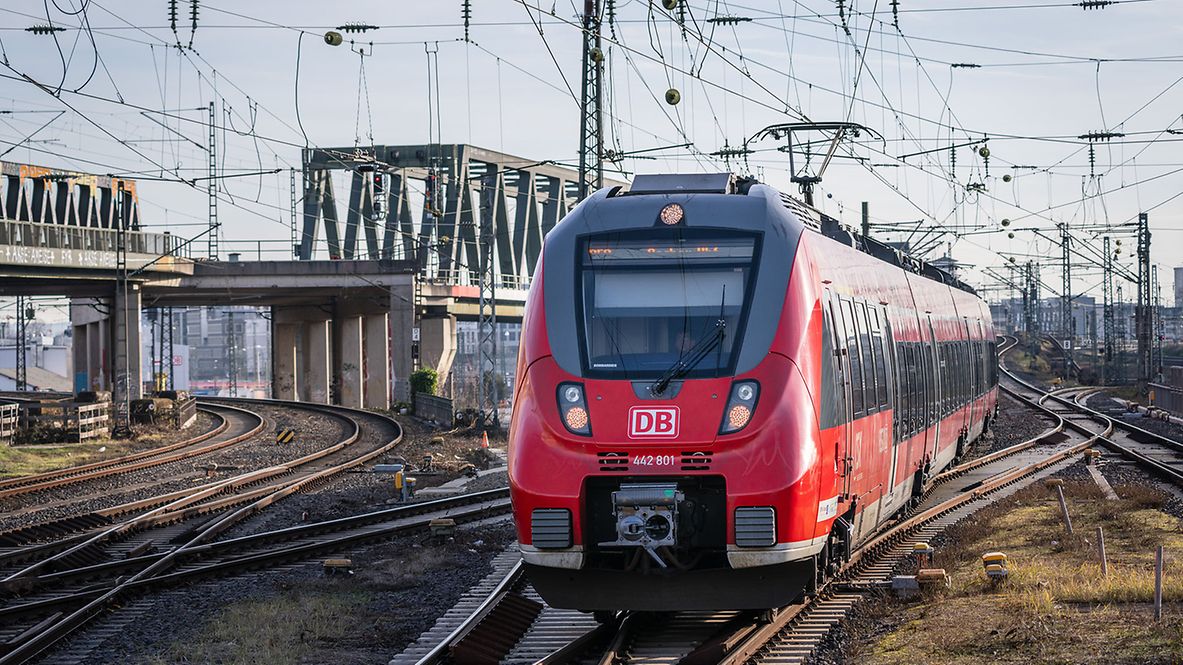
Attention Mobility Innovators: Apply now and shape the future of everyday mobility within our DB mindbox Regional Traffic Program!
Did you know that DB Regio is not just the biggest player of local rail passenger transport in Germany but also the largest operator of public bus services in Germany? DB Regio transports more than 6 million passengers per day and the numbers are continuously increasing. Therefore, DB mindbox is looking for new and innovative solutions to
- Increase the availability of vehicles
- Improve the efficiency of complex documentation processes
- Enable cost optimization in materials management
- Optimize operational processes
Develop your prototype and business model with us and open up new solutions for our passengers and employees. This is your chance to work with the DB Regio Bus and Schiene on the innovations of tomorrow. What are your benefits?
- Exclusive access to DB experts, data, markets & customers
- Access to an individual coaching program as well as mentoring experts
- EUR 25,000, no equity taken
You will get support of a dedicated DB mindbox startup manager, who is your bridge to the DB world. Plus, the option to work at our coworking space in the center of Berlin with 24/7 access.
This is a great opportunity to lay the foundation for joint projects and successful long-term collaboration with Deutsche Bahn Group, Europe’s largest mobility and infrastructure provider with more than 300.000 employees.
Sounds exciting, but still have questions? Check out our generell FAQ or join our upcoming open Q&A meetings on March 30th and April 7th from 12:00–12:30 CET via MS Teams.

Timeline
12.04.2026 – Application deadline
Last day to apply for the program
04.05.2026 – Announcement of candidates
Invitation of selected teams
21.05. 2026 – Selection day
Pitch your idea on stage to a jury and audience
08.06.2026 – Start of program
Start of the 100 day Proof-of-Concept to develop and test a prototype in cooperation with DB
17.09.2026 – End of program
End of 100 day Proof-of-Concept and presentation of results
FAQ
Disruption root cause analysis
Which data shall be analyzed?
It is part of the 100 days to analyze various data sets and data sources to identify which mix of data causes best results.
The following data, among others, is available for analysis: vehicle malfunctions from SAP, deviation information from the timetable, malfunction codes, malfunction inventories for individual vehicles, and social media.
What should the causes be analysed for?
Incidents are documented with so-called fine codes, which classify the causes of the incidents. Based on your data analysis, the appropriate DB Regio fine code should be assigned automatically.
Sensor-based prediction of door malfunction
Are certan trains the focus?
For the PoC, we are looking at the BR 423. However, it is desirable that the solution can be used for as many vehicle types as possible.
What does a solution need to include?
We are looking for easy-to-install sensors that detect abnormalities in door behavior and predict how quickly the malfunction will worsen. As a productive system, the information should be sent to the control center system and to SAP as a maintenance message. In the first step, a dashboard is sufficient.
Image-based damage documentation
What is the current process?
Train personnel can digitally record vehicle damage in DB system with a unique damage code. The quality of the findings is not sufficient for legally binding documentation or damage prognosis. Also, there is a lack of capacity to create damage reports, and information on vehicle location is not available. In order to improve the quality of the data transmitted to the authorities, a high level of manual post-processing is currently required.
What does the desired solution offer?
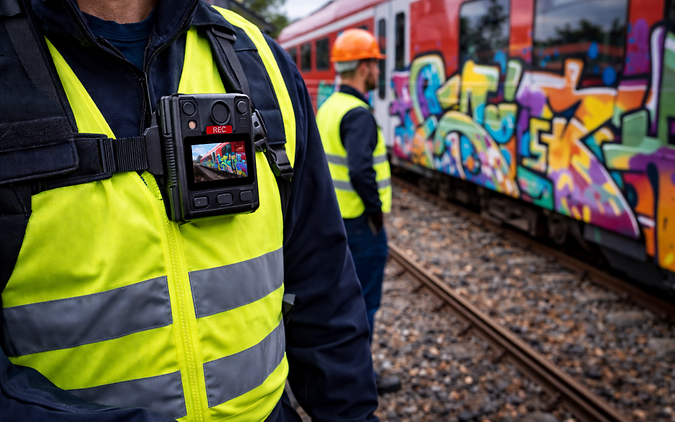
Bodycams worn by security personnel in parking lots record initial graffiti findings on vehicle exteriors, including vehicle number (UIC no.), parking location, and time, and transmits these results as one event/data packet via real-time communication tool between Bodycam and IDA (Intelligent digital assistant- DB tool). In IDA, the events/data packets are mapped with the findings from circulation and integrated into the existing data flow.
Which Bodycams are currently in use?
We are using Bodycams from netco. https://www.netco.de/body-cam/
Optimized stabling and rotation planning
Which movements of the vehicles shall be planned?
We consider the planning of movements and parking. This refers to vehicle movements after the last passenger journey and before the first passenger journey. During this time, a vehicle passes through several stations, including water disposal, exterior/interior cleaning, refueling, maintenance, and parking.
Which data sources will be used?
During the proof of concept, we will extract a data package consisting primarily of Excel and PDF documents. For pilot testing and scaling, interfaces with a wide variety of systems will be required; therefore, the system must be capable of processing a wide range of data formats
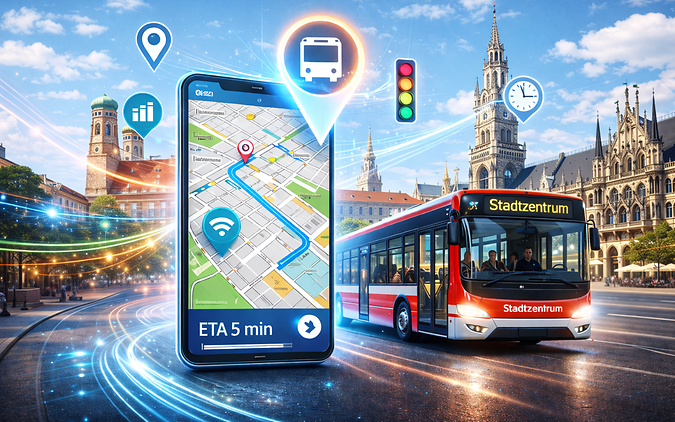
Real time route control for public buses
What features should a solution potentially offer?
We are looking for a georeferenced digital map with traffic attributes that is particularly suitable for bus transport and forms the basis for further applications. It is important to have high-performance real-time display and compression of very large quantities of moving objects, which must also be reflected in the UI/UX.
This map should offer at least 5 map layers and must be editable so that road closures and diversions can be incorporated manually. Buses are displayed as digital twins in real time in the system. The updated route is then transmitted to the bus driver in real time.
In addition, the system should be intelligent enough to use historical data to make schedule-based predictions about the location of the bus, even if it is not currently sending its location.
It should be possible to derive context-related dispatching measures, such as suggesting alternatives directly based on the route, but also to set the routes yourself. The system also recognizes correlations with connecting trips and informs the dispatcher that a connecting connection cannot be maintained as planned.
What data should the digital twin contain?
Extended bus route data (stops), dynamic content (road closures, stop closures), configuration (bus navigation), bus status (e.g., passenger counts, disruptions), but especially position data, timetable data, forecasts, and driving data specifications.
 Go
Go